Hungry Shark World
- 4.7
- Rating
- 100.00M
- Installs
- Free
- Price

 Analysis by App-foxy
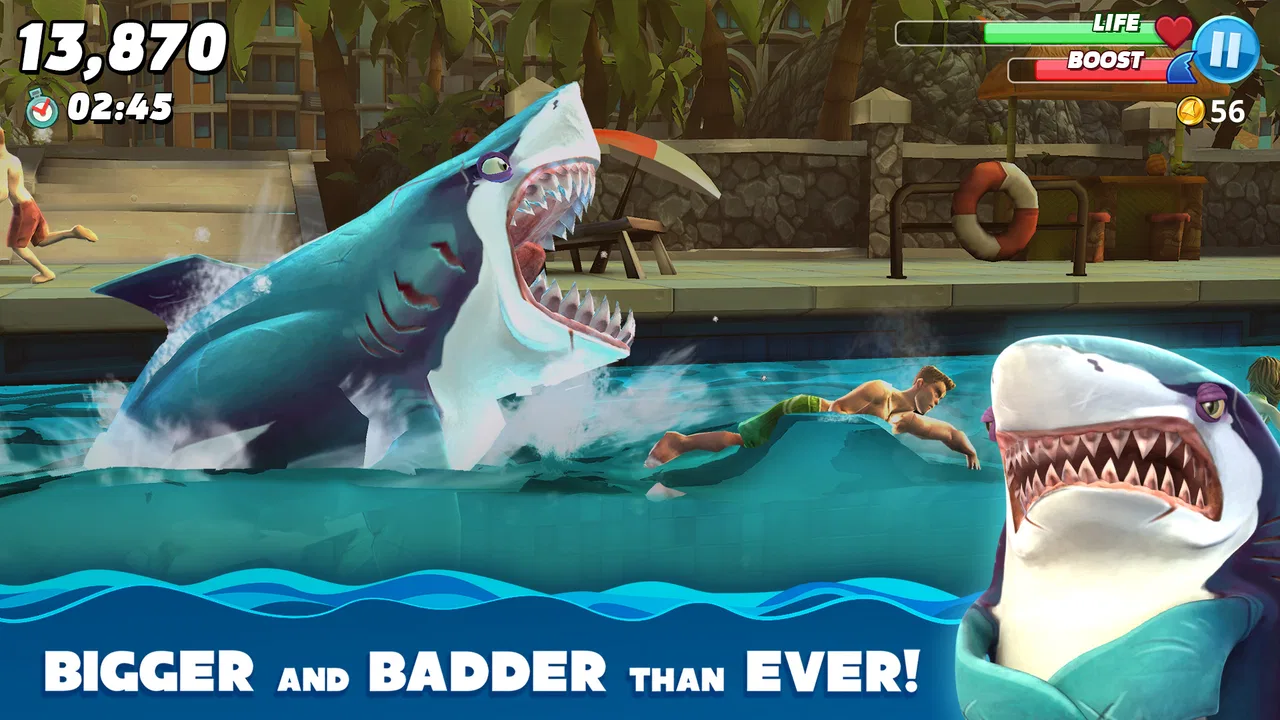
Hungry Shark World is the kind of arcade game I open when I want immediate action rather than a long tutorial or a complicated story. I guide a hungry shark through the ocean, look for food, avoid danger, and try to stay alive long enough to make each run worthwhile. That simple loop is easy to understand, but it becomes surprisingly demanding once I start chasing better routes and taking bigger risks.
After spending time with Hungry Shark World, I found that its strongest quality is how quickly it turns a spare moment into a playable session. The game is free to download, developed by Ubisoft Entertainment, and listed for Teen players. Its store summary reduces the idea to eating, fishing, attacking, and surviving, but the real appeal is the constant decision-making: do I keep pushing into a dangerous area for better rewards, or retreat while the shark is still healthy?
How the game feels during a normal session
The first few minutes are deliberately approachable. Movement is direct, the objective is visible through the action, and I never feel buried under instructions. That makes the game suitable for a quick break on a phone, especially when I do not want to remember a complicated control scheme. The arcade format also means I can stop after a short attempt without losing the thread of a large campaign.
You May Also Like

 Blood Strike: 2.5 Anniversary
Blood Strike’s Loadouts Turn Every Drop Into a Tactical Gamble
A close look at Blood Strike’s custom loadouts: how fast access to signature weapons reshapes its battle royale rhythm, rewards preparation, and narrows the gap between fights.

 Pandora - Music & Podcasts
Pandora’s Music Is Easy to Start, but Harder to Recover
Pandora’s strength is its low-effort path from a seed to a station. Its weak spot is how much confidence it asks you to place in connection, setup, and quiet recovery.

 8 Ball Pool
 Is Built on Rivalries, Rematches, and Routine
A close look at the rivalries, rematches, shared routines, and unanswered safety questions that turn a quick pool match into a persistent mobile community.

 Samsung Music
’s Quiet Strength Is Playing What You Already Own
Its reach comes less from spectacle than from dependable access to a personal library. That simplicity is both the app’s strongest retention engine and its ceiling.

 AccuWeather: Weather Radar
AccuWeather Review: A Quick, Clear Forecast for Everyday Decisions
For everyday plans, the best forecast is the one you can understand quickly. AccuWeather makes rain timing, radar, and local conditions easy to act on, with a few trade-offs.

 Hill Climb Racing
Why Hill Climb Racing Still Turns Crashes Into One More Run
A tiny car, a bumpy hill and one more upgrade: Hill Climb Racing keeps resurfacing because its simple chaos makes every near-miss feel personal.
More From Our News Desk
View All News


What keeps the experience from becoming completely mindless is the need to read the environment. Smaller prey may be safe and useful, while larger targets or hazards can end a run quickly. I have to watch where the shark is going, not just what is directly in front of it. A careless dash can turn a promising attempt into a recovery exercise, particularly when I become too focused on collecting food.
The pace is generally brisk because the game puts the shark in motion and asks me to react continuously. It is not a slow exploration game where I can pause to study every corner. That speed is enjoyable when I am alert, but it can also make mistakes feel abrupt. Players who prefer calm puzzle games or turn-based arcade alternatives may find the constant movement tiring rather than exciting.
One useful habit is to treat each run as a route-planning exercise instead of a simple feeding frenzy. I look for safe targets first, learn which areas let me turn around comfortably, and avoid spending all of the shark’s health on one tempting encounter. This approach makes progress feel more deliberate and reduces the frustration of repeatedly losing because I chased the largest visible target.
Why the short-session design works
In an everyday situation, I could play during a commute break, while waiting for an appointment, or between other tasks. A single run gives me a clear beginning and end, so I do not need a large uninterrupted block of time. That is one of the better reasons to choose this game over a lengthy role-playing title: the commitment is easy to control.
At the same time, the game can stretch a short break into a longer session because a failed run naturally invites another attempt. I often think, “I know what went wrong this time,” and restart immediately. That retry impulse is central to the design. It is satisfying when I can correct a mistake, but it may be irritating for anyone who is trying to limit screen time.
The visual presentation supports the arcade tone without requiring me to understand a complicated narrative. I can focus on movement, targets, and survival. For a player who wants a game with a strong story, detailed character conversations, or a slower sense of discovery, this is not the right match. Its personality comes from action and escalation rather than from dialogue.
Where speed becomes a challenge
The perceived speed changes with the situation. Moving through a relatively safe section feels relaxed enough, while crowded encounters demand quick reactions and better positioning. The important distinction is that the game does not only test how fast I can respond; it tests whether I entered the situation with enough room to escape.
That is why I would not judge the game only by its first impression. New players may rush because the goal seems obvious, then discover that survival depends on restraint. I get better results when I approach valuable targets from an angle that leaves a retreat path. It is a small tactical adjustment, but it changes the game from random movement into controlled risk.
Players should also expect the experience to feel less comfortable on a small screen if their fingers cover the action. A larger display gives me more visual space to follow the shark and identify threats early. This is not a separate game mode or a hidden advantage; it is simply a practical difference in how easy it is to read fast-moving action.
Heavy-use moments, stability, and device demands
The busiest moments are the ones where several decisions arrive together: I am moving quickly, searching for food, avoiding an attack, and trying not to trap the shark in a poor position. Those moments are where the game feels most intense. They are also where any weakness in my own timing becomes obvious, so I try not to confuse a difficult encounter with a technical problem.
Because this is a 3D arcade game with active movement and a constantly changing play area, I would give it more attention than an extremely lightweight card or word game when choosing a device. The published minimum is Android 8.0, which makes the compatibility range fairly broad, but minimum compatibility should not be mistaken for identical comfort on every phone. Screen size, age, thermal condition, and available storage can all affect how pleasant a demanding game feels in practice.
I avoid starting a serious run when my phone is already hot or overloaded with other demanding apps. That is a sensible routine for any action game, but it matters particularly here because a brief interruption can affect steering and timing. Closing unused apps, keeping the operating system reasonably current, and leaving enough free storage are practical ways to reduce avoidable friction without pretending they guarantee perfect performance.
The game has reached over 100 million installs and carries an average rating of 4.6 from around 2.3 million ratings. Those figures suggest a large and active audience, but they do not tell me how it will behave on my specific phone. I still judge the experience by whether controls remain responsive, whether sessions stay comfortable, and whether the device handles longer play without becoming unpleasantly warm.
For resource-conscious players, the important trade-off is straightforward: this offers more visual and action density than a basic two-dimensional arcade title, so it may demand more from a phone. In return, I get a richer environment and a stronger feeling of movement. If a device is older or already struggles with modern games, a simpler alternative may provide a smoother experience even if it looks less ambitious.
What I watch during longer sessions
During a longer play period, I pay attention to three things: whether input still feels immediate, whether the phone becomes uncomfortable to hold, and whether returning to the game after an interruption is painless. These are more useful questions than simply asking whether the game launches. A game can open successfully and still be a poor fit if extended play causes heat, battery anxiety, or frequent interruptions.
I also recommend checking the current version before judging an installation. The listed current version is 7.5.7, so players should make sure they are not evaluating an outdated build when an update is available. Keeping the game current is especially sensible for a long-running mobile title, although an update can never replace the need to consider the limits of the device itself.
Recovery is part of the overall experience. When I lose a run, I want to understand why and get back into the action without a complicated setup. The arcade structure supports that rhythm well. A failed attempt is usually useful because it teaches me which target, route, or moment of overconfidence caused the problem. That makes restarting feel like practice rather than a complete waste of time.
Still, recovery is not equally satisfying for everyone. If I am already frustrated, the same retry loop can feel repetitive. The game asks me to accept failure as part of improvement, so players who want steady, predictable progress may prefer a more relaxed arcade experience. I would recommend taking short breaks rather than forcing repeated attempts after my attention has clearly dropped.
Free access and spending decisions
The game is free, which makes it easy to try without committing money at the start. It also includes in-app purchases ranging from $0.99 to $99.99 per item. I would approach those purchases carefully, especially because the retry-driven structure can make a player feel tempted to speed up progress after a disappointing run.
My advice is to play long enough to decide whether the core movement and survival loop are enjoyable before spending anything. If the basic game already feels repetitive or too demanding, a purchase will not fix that mismatch. On the other hand, someone who genuinely likes the arcade loop may see optional spending as a convenience, provided it stays within a clear personal budget.
This is also where the game differs from a completely self-contained paid arcade title. A one-time purchase can feel cleaner for players who dislike in-app buying, while the free entry here lowers the barrier for casual experimentation. Neither approach is automatically better; the right choice depends on whether I value free access and gradual engagement more than a single upfront transaction.
Reliability in everyday use
My view of reliability includes more than whether the game crashes. It includes predictable controls, understandable failure, and the ability to resume the habit of playing without confusion. Hungry Shark World works best when I treat it as a focused arcade session: launch it, play deliberately, and close it when I am finished rather than leaving it competing with many other demanding tasks.
The large install base and substantial review activity make it easier to see that this is an established mobile game rather than an obscure experiment. It has around 96 thousand written reviews and has been available since May 4, 2016. Longevity is reassuring in the sense that the concept has had time to find an audience, but it does not remove the normal differences between phones, operating systems, and personal tolerance for mobile monetization.
One strength is the clarity of the central loop. If I return after several days away, I do not need to reconstruct a complicated plot before playing. I can immediately remember the basic priorities: eat what is safe, attack when the situation allows it, and avoid turning ambition into an unnecessary early defeat.
One weakness is that the same clarity can become repetition if I am not enjoying the chase itself. There is no point pretending this is a broad collection of unrelated activities. Its identity is built around the shark, the ocean, and the escalating pressure of survival. Players seeking frequent changes of genre or a deep social layer should look elsewhere.
Who should install it, and who should skip it
I would recommend it to players who enjoy fast arcade action, short repeatable sessions, and learning through trial and error. It is especially suitable for someone who likes the feeling of starting small, becoming more confident, and testing how far a run can go. The Teen content rating is worth considering for families, so I would not treat it as an automatic choice for young children.
I would be more cautious about recommending it to people with limited storage, older hardware, or a strong dislike of in-app purchases. The Android 8.0 minimum gives a clear baseline, but a compatible operating system does not promise that every device will feel equally smooth. If a player mainly wants a quiet, low-demand game for battery-conscious moments, a simpler arcade alternative is likely a better fit.
It is also not my first choice for someone who wants a traditional platformer with precise fixed levels. Here, the pleasure comes from navigating an active environment and managing risk rather than memorizing a sequence of jumps. Likewise, fans of realistic simulation may find the exaggerated arcade approach too playful. The game knows exactly what it is, and its strengths are tied to that narrow focus.
My performance verdict
After weighing speed, heavy-use moments, device demands, and recovery, I see Hungry Shark World as a strong choice for action-focused mobile players who want a free game that can fill five minutes or hold attention for much longer. Its controls are easy to grasp, but surviving well requires more care than the simple premise suggests. I enjoy that gap between accessibility and mastery.
The main caution is not that the game is inherently unreliable; it is that the experience depends on the phone and on the player’s tolerance for repeated attempts, active movement, and optional spending. I would keep the device in good shape, avoid judging performance while many demanding apps are open, and set a spending limit before making purchases.
With an average rating of 4.6, more than 100 million installs, and a free starting point, the game has a clear reason to attract a broad audience. My own recommendation is narrower and more useful: try it if you want energetic shark-centered arcade play and enjoy improving through repeated runs. Skip it if you need a quiet, low-resource experience or prefer games that deliver progress without pressure.
For me, the best sessions are the ones where I stop chasing every possible target and start making intentional choices. That is when the game feels less like frantic tapping and more like a compact survival challenge. The real strength is not simply eating everything in sight; it is knowing when the next bite is worth the risk.
FAQs for Hungry Shark World
01What is Hungry Shark World about?
Hungry Shark World is an action-packed adventure game where players control a variety of sharks as they swim through the ocean, feeding on everything from fish to humans. The game features multiple levels, diverse environments, and a wide selection of sharks each with unique abilities and upgrades.
02Is Hungry Shark World free to play?
Yes, Hungry Shark World is free to download and play. However, it includes optional in-app purchases that can enhance gameplay by providing faster access to upgrades or special items. While these purchases can improve the experience, they are not necessary to enjoy the full game.
03What are the system requirements for Hungry Shark World?
Hungry Shark World requires iOS 9.0 or later for Apple devices and Android 5.0 or higher for Android devices. It's compatible with most modern smartphones and tablets, but for the best experience, ensure your device meets these requirements and has enough storage space available.
04Can I play Hungry Shark World offline?
Hungry Shark World can be played offline, allowing you to enjoy the game without an internet connection. However, certain features such as leaderboard rankings or special events might require an internet connection to function properly. It’s best to connect occasionally to access all game features.
05How do I upgrade my sharks in Hungry Shark World?
In Hungry Shark World, you can upgrade your sharks by earning coins and gems through gameplay. These can be used to enhance your shark’s abilities, such as speed, bite, and boost. Additionally, completing missions and leveling up unlocks new and more powerful sharks for you to control.
Pros
- Stunning graphics and animations.
- Intuitive and responsive controls.
- Wide variety of sharks to unlock.
- Engaging missions and challenges.
- Frequent updates with new content.
Cons
- Can be repetitive over time.
- In-app purchases can be pricey.
- Requires a stable internet connection.
- Some levels feel unbalanced.
- Ads can interrupt gameplay.

Hungry Shark World
Gallery